

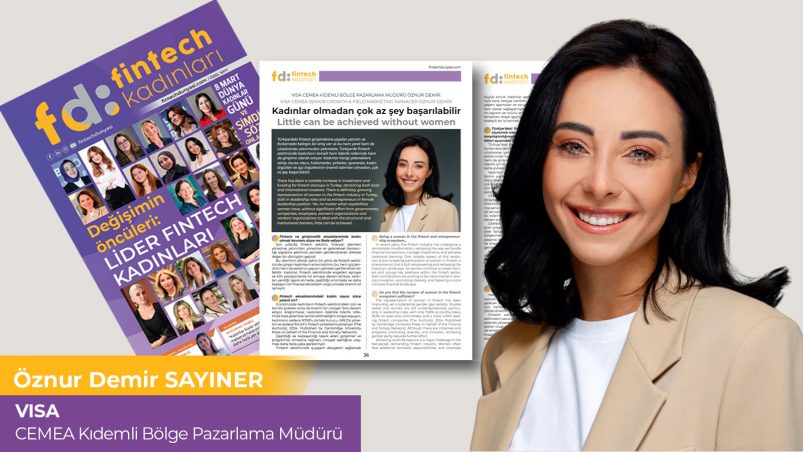

There has been a notable increase in investment and funding for fintech startups in Turkey, attracting both local and international investors. There is definitely growing representation of women in the fintech industry in Turkey, both in leadership roles and as entrepreneurs in female leadership position. Yet, no matter what capabilities women have, without significant effort from governments, companies, employers, women’s organizations and workers’ organizations to deal with the structural and institutional barriers, little can be achieved.
VISA CEMEA Senior Growth & Field Marketing Manager Öznur Demir
- Being a woman in the fintech and entrepreneurship ecosystem…
In recent years, the fintech industry has undergone a remarkable transformation, reshaping the way we handle financial transactions, manage investments, and perceive traditional banking. One notable aspect of this revolution is the increasing participation of women in fintech, a phenomenon that is both empowering and reshaping the industry’s landscape. As women continue to break barriers and occupy key positions within the fintech sector, their contributions are proving to be instrumental in driving innovation, promoting diversity, and fostering a more inclusive financial landscape.
- Do you find the number of women in the fintech ecosystem sufficient?
The representation of women in fintech has been improving, yet a substantial gender gap persists. Studies reveal that women are still underrepresented, particularly in leadership roles, with only 7.69% as (co-)founders, 18.2% on executive committees, and a mere 4.04% leading fintech companies (The Author(s), 2024. Published by Cambridge University Press on behalf of the Finance and Society Network). Although there are initiatives and programs promoting diversity and inclusion, achieving gender parity requires further effort.
Achieving work-life balance is a major challenge in the fast-paced, demanding fintech industry. Women often face additional domestic responsibilities, and corporate cultures frequently fail to provide the necessary support for different life stages and responsibilities
I am convinced that enhancing the representation of women in fintech goes beyond merely balancing the numbers; it is a strategic business move for the fintech sector.
- What would you like to say about fintech initiatives in Turkey? Do you observe differences in terms of the number of women leaders and other characteristics when comparing the global and CEMEA regions?
There has been a notable increase in investment and funding for fintech startups in Turkey, attracting both local and international investors. There is definitely growing representation of women in the fintech industry in Turkey, both in leadership roles and as entrepreneurs in female leadership position. Yet, global average for female leadership in fintech tends to be higher than in Turkey, as well as higher than in CEMEA.
Globally, there has been a gradual increase in the representation of women in leadership roles across various sectors. However, the pace of change varies significantly by region and industry. Women hold approximately 25-30% of senior management positions globally, though this varies widely by country and industry. Many multinational corporations have implemented policies to promote gender diversity, including mentorship programs, diversity quotas, and flexible working conditions.
The representation of women in leadership roles in CEMEA varies significantly between sub-regions. Central Europe tends to have higher female representation compared to the Middle East and Africa. In many parts of the Middle East and Africa, cultural and societal norms continue to pose significant barriers to women’s participation in the workforce and leadership roles. Access to education for women has been improving in many CEMEA countries, but disparities remain, particularly in rural and underserved areas. There is more variation in policy and legislative support for gender diversity in leadership within the CEMEA region, with some countries making significant strides while others lag behind.
Yet, no matter what capabilities women have, without significant effort from governments, companies, employers, women’s organizations and workers’ organizations to deal with the structural and institutional barriers, little can be achieved.
- Can you summarize the development and future of the fintech ecosystem in three words?
Inclusivit., Disruptive. Digitalization
- What advice would you give to women who want to pursue a career in fintech? Where should they start?
By seeking guidance and mentorship, advocating for themselves, staying adaptable, and actively participating in industry events, aspiring women can position themselves for leadership and drive innovation in the fintech industry.
By championing the inclusion of more women in fintech, we can foster a diverse and dynamic industry that benefits from a wide range of perspectives and talents. Ultimately, the goal is to create a more balanced ecosystem where both women and men have equal opportunities to contribute and succeed together.
- Would you like to talk about your own fintech journey and add anything else?
My career journey in the payment industry began three years ago at Visa. Prior to this, I spent 12 years working in the consumer electronics and FMCG industries. Reflecting on what has been the most significant and useful tool in my journey, I realize it was the women who mentored me. These mentors helped shape my abilities and contributions, enabling me to excel in my field. Engaging and learning with people from diverse backgrounds and cultures provided me with invaluable perspectives and experiences.
